Why SUVs Used for Weekend Desert Trips Need Extra Suspension Checks
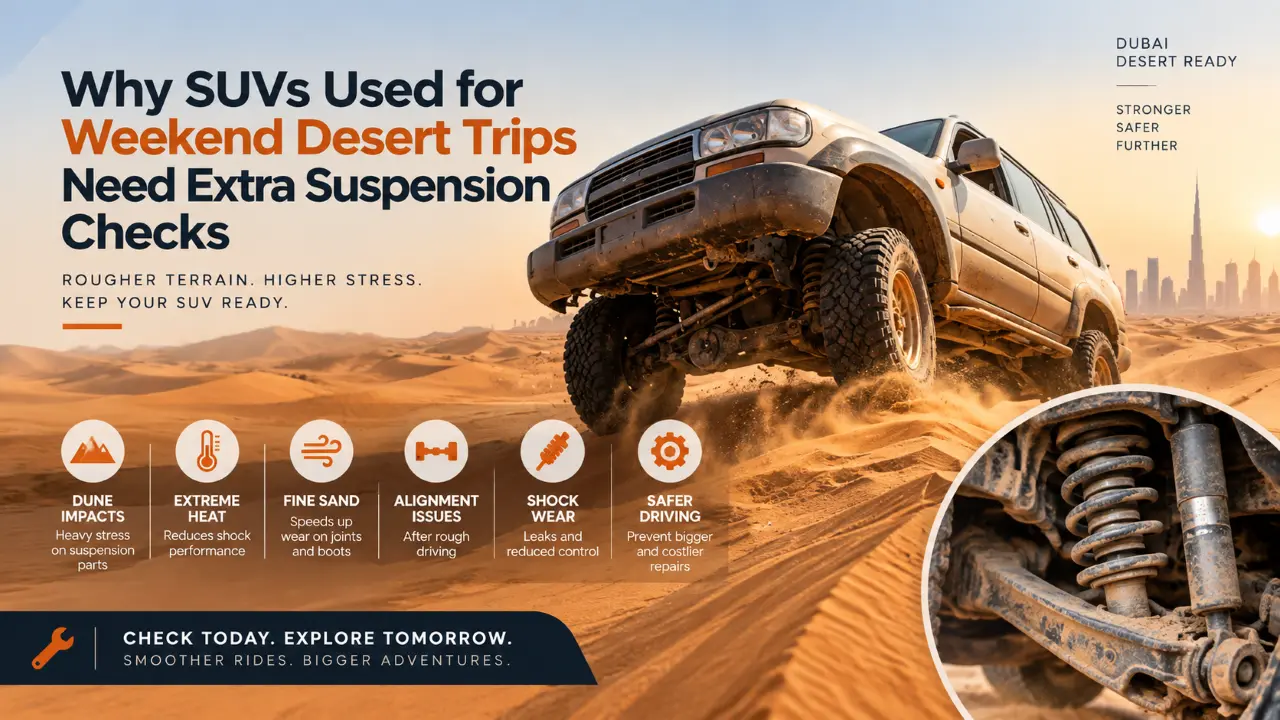
A family SUV may spend most of the week driving through Dubai traffic, but weekend desert trips can put its suspension under a very different kind of stress. Dune driving creates hard impacts, rapid suspension movement, heat, and constant contact with fine sand.
SUVs used for desert trips need extra suspension checks because these conditions can wear shocks, springs, bushings, ball joints, and other parts much faster.
A vehicle that feels normal on city roads may still have hidden damage after repeated dune driving. Regular checks help find these problems before they affect handling, comfort, or safety.
Reasons Why SUVs Used for Weekend Desert Trips Need Extra Suspension Checks
1. Dune Impacts Put Heavy Stress on Suspension Parts
Dune bashing forces an SUV to move through large changes in height within a short time. Landing after a dune crest or dropping into a soft sand bowl can make the suspension compress very quickly. The shocks, springs, control arms, and other parts must absorb this force.
Why Hard Landings Matter
A hard landing can push the suspension close to its full travel. Repeated impacts may weaken components over time, even when there is no obvious damage. This is why desert drivers should check for new noises, changes in ride quality, or unusual movement after a trip. A post-trip inspection can reveal early signs of wear before a small issue becomes a larger repair.
2. Bottoming Out Can Damage Key Components
An SUV can bottom out when the suspension reaches the end of its available travel. This can happen when the vehicle drops suddenly into a deep section of sand or lands heavily after crossing a dune.
The impact can place a strong load on bump stops, shock mounts, springs, and suspension arms. Repeated bottoming can also create stress around mounting points. In some cases, the damage may not be easy to see without a proper inspection.
Drivers who frequently take their SUVs into the desert should have these areas checked regularly, especially after a trip involving hard landings or rough dune crossings.
3. Desert Heat Can Reduce Shock Absorber Performance
High temperatures are another major concern for SUVs used in Dubai’s desert. Shock absorbers contain hydraulic fluid that helps control suspension movement. During demanding off-road driving, the shocks work continuously while the outside temperature is already high.
What Happens When Shocks Overheat?
Excessive heat can reduce the effectiveness of the fluid and cause the shocks to lose some of their ability to control bouncing. The SUV may begin to feel less stable over uneven ground.
Long periods of hard driving can also place extra stress on seals inside the shock absorber. Checking for leaks and reduced damping after desert trips can help identify problems before they affect normal road driving.
4. Fine Sand Can Wear Suspension Joints
Desert sand is extremely fine and can reach areas that are normally protected from dirt. When sand gets around suspension joints, mounts, and protective boots, it can increase friction and speed up wear. This is especially important for SUVs that regularly travel through dunes.
Parts That Need Attention
- Ball joint protective boots
- Control arm bushings
- Steering components
- CV joint boots
- Suspension mounts
- Shock absorber shafts
Sand can also mix with grease if a protective boot is damaged. This can create an abrasive mixture that wears internal surfaces. Cleaning and checking these areas after repeated desert use can help prevent expensive component failure.
5. Rubber Bushings Can Wear Faster
Suspension bushings help reduce vibration and allow controlled movement between different parts. They are made from rubber or similar materials that can become harder and weaker with age.
High desert temperatures can speed up this process, especially when the vehicle is exposed to heat regularly. Hard dune impacts add another source of stress. A bushing that is already becoming weak may crack or tear after repeated off-road use.
Worn bushings can cause knocking sounds, uneven handling, and unwanted suspension movement. Checking them as part of regular maintenance is important for SUVs that move between desert trails and daily city roads.
6. Hard Dune Driving Can Affect Wheel Alignment
Suspension components are designed to keep the wheels at specific angles. Hard landings, deep ruts, and sideways movement on dunes can place unusual loads on control arms and steering parts. If something moves out of position, the wheel alignment may change.
Misalignment can become easier to notice once the SUV returns to paved roads. The vehicle may pull slightly to one side, the steering wheel may no longer sit straight, or the tires may start wearing unevenly.
A post-trip alignment check can be useful when an SUV has experienced heavy impacts. Finding alignment problems early can protect the tires and help restore normal steering response.
7. Shocks Can Develop Leaks After Repeated Trips
Shock absorbers have seals that keep hydraulic fluid inside the unit. These seals work in a hot and dusty environment when an SUV is used for desert driving.
Fine sand around the shock shaft can increase wear, while repeated suspension movement puts additional pressure on the seals.
Signs of a Possible Shock Problem
- Wet or oily marks around the shock body
- More bouncing after bumps
- Excessive body movement
- Uneven ride quality
- Reduced stability during turns
A leaking shock should not be ignored. Once fluid is lost, the shock may not control suspension movement properly. An early inspection can help determine whether the unit needs repair or replacement.
8. Desert Use Can Loosen or Stress Mounting Hardware
Suspension systems are held together by many bolts, mounts, and connection points. Continuous vibration and strong impacts can place extra stress on this hardware. While a single trip may not cause a serious issue, repeated desert driving can increase the chance of looseness or wear.
Technicians can inspect suspension mounting points, control arm connections, shock mounts, and related hardware during a post-trip check.
Any unusual movement should be investigated rather than ignored. Loose hardware can change how the suspension behaves and may create additional stress on nearby components.
9. Small Problems Can Become Serious on the Highway
One of the biggest reasons to inspect a desert-driven SUV is that the vehicle may return to normal city roads before a suspension problem becomes obvious. A weak shock, worn ball joint, damaged bushing, or alignment issue may not seem serious at low speeds on sand.
However, highway driving places different demands on the vehicle. Poor damping can affect stability during lane changes, while loose steering or suspension parts can reduce control.
Drivers who use their SUVs for both daily commuting and weekend desert trips should therefore treat post-trip suspension checks as part of responsible maintenance.
What to Check After a Desert Trip?
A basic inspection after heavy dune driving can help identify visible problems before the SUV returns to regular use. Drivers can look for signs of leaks, damage, loose parts, or torn protective boots. More detailed checks should be handled by a qualified technician.
Useful Post-Trip Checks
- Shock absorbers: Look for oil or dark wet marks around the shock body.
- Rubber boots: Check CV joints, ball joints, and steering components for tears.
- Suspension joints: Look for unusual movement or looseness.
- Mounting points: Check for damaged or loose hardware.
- Tires: Look for uneven wear or visible damage.
- Wheel alignment: Check for pulling or a steering wheel that sits off-center.
These checks are especially useful after a trip with hard landings, deep sand, or repeated dune impacts.
When Should You Get Professional Suspension Repair?
Not every desert trip will damage an SUV, but repeated hard use increases wear. If the vehicle develops a new noise, starts bouncing more than normal, pulls to one side, or shows uneven tire wear, it should be inspected.
For Dubai drivers who regularly use their SUVs for desert trips, professional car suspension repair in Dubai can help identify worn components before they become a safety concern.
A technician can inspect mechanical parts, check for leaks, test suspension movement, and look for alignment problems. This is more reliable than waiting until a part fails.
Conclusion
Weekend desert trips can be exciting, but they expose SUVs to conditions that normal city driving does not. Hard dune impacts, bottoming out, extreme heat, fine sand, worn rubber parts, alignment changes, fluid leaks, and stressed mounting hardware can all affect suspension performance.
Extra suspension checks help catch these issues before they affect highway driving or lead to expensive repairs. If your SUV regularly travels through Dubai’s desert, paying attention to new noises, uneven handling, ride changes, and visible leaks is important.
Timely car suspension repair in Dubai can help keep the vehicle stable, comfortable, and ready for both weekday roads and weekend adventures.